Pokémon TCG Decks: 7 Best Ways to Build and Win With Proven Lists
Whether you are opening your first box or preparing for a League Cup, the right deck changes everything. Pokémon TCG decks come in many forms, from ready-to-play preconstructed products to carefully tuned 60-card tournament lists. This guide explains the main types of decks you can buy, how to build your own, and which archetypes are worth watching at the time of writing (November 2026).
The basics of Pokémon TCG decks
Every standard Pokémon TCG deck has exactly 60 cards, with no more than four copies of any card with the same name (basic Energy is the exception). A deck mixes three card types:
- Pokémon: your attackers and support Pokémon, including Basic Pokémon and their evolutions.
- Trainer cards: Items, Supporters, Stadiums and Pokémon Tools that let you search, draw, switch and disrupt.
- Energy cards: fuel for attacks.
You win by taking all your Prize cards, knocking out every Pokémon your opponent has in play, or by your opponent being unable to draw at the start of their turn. Pokémon ex and Mega Evolution Pokémon ex give up extra Prize cards when knocked out, which shapes how many decks are built.
Types of preconstructed Pokémon TCG decks
If you do not want to build from scratch, preconstructed Pokémon TCG decks are the fastest way to start. Each product targets a different kind of player.
League Battle Decks
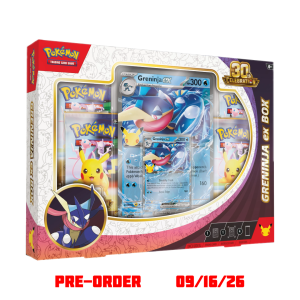
League Battle Decks are the most competitive preconstructed products. They are designed around a proven strategy and include multiple copies of key Trainer cards, so they work right away at a local league. Recent examples include the Mega Lucario ex League Battle Deck and the Mega Greninja ex League Battle Deck, which was announced for November 11, 2026 with Mega Starmie ex and Meowth ex in the list. Contents typically include damage-counter dice, condition markers, a deck box and a code card for Pokémon TCG Live.
ex Battle Decks and other battle decks
ex Battle Decks are entry-level 60-card decks, each built around a single Pokémon ex. They are affordable and simple, which makes them perfect for learning. Many players buy two and play them against each other. Special editions also appear, such as the battle decks in the Pokémon 30th Celebration lineup.
Theme decks and Trainer kits
Theme decks were the classic preconstructed product for many years, and you will still see them on the collector market. Today, Trainer kits, Battle Academy and starter products fill the “learn to play” role, with guided first games and clear rules inserts.

Which preconstructed deck should you buy?
- Total beginner: start with an ex Battle Deck or a learn-to-play box.
- Casual player ready for more: a League Battle Deck gives you a real tournament-style engine.
- Parent buying for kids: pick two battle decks so they can play each other straight away.
- Future competitor: buy a League Battle Deck, then upgrade it with singles from our Pokémon singles.
Products from the 30th Celebration and Mega Evolution eras are good places to begin, and you can browse sealed items in our booster boxes and upcoming releases in our Pokémon pre-orders.
How to build Pokémon TCG decks from scratch
Building your own Pokémon TCG decks is where the game gets really rewarding. A reliable starting framework is roughly 15 Pokémon, 35 Trainers and 10 Energy, though every archetype adjusts those numbers.
Step 1: choose your main attacker
Pick one or two Pokémon that will deal most of your damage. Look at their attack cost, damage output and how many Prize cards they give up. A single-Prize attacker trades well against big ex Pokémon; a big ex Pokémon hits harder but is riskier.
Step 2: build a consistent evolution line
For Stage 2 Pokémon, a 4-3-4 or 4-2-4 line (Basic, Stage 1, Stage 2) with Rare Candy is common. Basic attackers need fewer slots. Consistency comes first: a deck that cannot set up rarely wins.
Step 3: add draw and search
Supporters that draw cards and Items that search for Pokémon are the engine of every list. Most competitive decks run a large count of these, along with an Ultra Ball style search card. Check which versions are legal in the current Standard format.
Step 4: include switching and recovery
Your deck needs ways to move Pokémon between the Active Spot and the Bench, and ways to get key cards back from the discard pile. Two or three switching cards and one recovery card is a typical starting point.
Step 5: set your Energy count
Count how much Energy your attacker needs per turn. Decks with Energy acceleration can run less; decks that attach once per turn usually need more. Test and adjust.
Step 6: playtest and tune
Play at least ten games before major changes. Track why you lose: dead hands, missing Energy or not enough damage. Adjust one or two cards at a time.
Standard format and rotation
Standard is the main competitive format. In 2026, cards with the G regulation mark rotated out, which removed several long-time staples and archetypes from Scarlet & Violet era sets. At the time of writing (November 2026), Standard uses cards with the H regulation mark and later, plus newer Mega Evolution era releases.
Before you build or buy singles, check the regulation mark in the bottom corner of each card and confirm legality on the official Pokémon TCG site. Rotated cards are still great for Expanded or casual games at home.
Popular archetypes for Pokémon TCG decks in late 2026
The meta moves quickly after every set release and tournament, so treat this as a snapshot rather than a final ranking. These archetype families tend to define competitive Pokémon TCG decks:
- Aggressive Basic ex decks: Pokémon like Raging Bolt ex, which was a top performer in summer 2026 meta reports, attach lots of Energy quickly and hit hard from turn two.
- Mega Evolution ex decks: the Mega era introduced powerful Mega Pokémon ex such as Mega Lucario ex and Mega Greninja ex. They give up more Prize cards but swing games with huge attacks.
- Stage 2 engine decks: slower setups that use Rare Candy and draw-ability Pokémon to build a powerful board.
- Single-Prize toolbox decks: a mix of non-ex attackers that make your opponent take six Knock Outs instead of three.
- Control and disruption: decks that limit your opponent’s hand, Energy or Bench and win through attrition.
For up-to-date lists, follow official Play! Pokémon tournament results, and be cautious about copying a list without understanding why each card is there.
Common mistakes when building Pokémon TCG decks
- Too many attackers, not enough support. Six different attackers with one copy each rarely works.
- Thin evolution lines. One Stage 1 and one Stage 2 almost guarantees you never evolve.
- Ignoring Prize math. Count how many Knock Outs your opponent needs to win against your board.
- Not enough draw. Most losses come from dead hands, not bad attacks.
- Playing rotated cards in Standard. Always check regulation marks before an event.
Upgrading a preconstructed deck
Upgrading is the best middle path between buying and building Pokémon TCG decks. Start with a League Battle Deck, then:
- Add a fourth copy of the most important draw Supporter.
- Thicken the main attacker line for consistency.
- Swap weak Trainers for stronger, current Standard versions.
- Add a tech card for the matchup you lose most often.
Pick up missing cards in our Pokémon singles, and protect your finished list with sleeves and a deck box from our accessories. Duplicates from packs can be swapped for store credit through our sell and trade program.
Testing Pokémon TCG decks online and at the table
Most League Battle Decks and many battle decks include a code card for Pokémon TCG Live, which makes it easy to test lists before buying singles. Playtesting online is fast, but nothing beats real games at a local league, where you face a wide range of Pokémon TCG decks and learn from more experienced players.
- Log your games. Note the matchup, who went first and why you won or lost.
- Test against the popular decks. Your list should have a plan against the archetypes you see most often.
- Practice your opening turns. Shuffle and draw opening hands to see how often you set up well.
- Ask for feedback. Players at leagues are usually happy to suggest changes.

Pokémon TCG decks for kids and families
Pokémon TCG decks are a wonderful family activity because they teach math, reading and strategy in a fun way. For younger players, two matching battle decks are ideal: everyone plays with the same power level, and games stay quick. As kids grow more confident, they can start swapping cards between decks and eventually build their own.
Keep things simple at first. Skip complex rules until the basics click, and let children choose decks with their favorite Pokémon. Excitement about the characters is often what keeps them playing long enough to learn the deeper strategy.
Budgeting for Pokémon TCG decks
Pokémon TCG decks can cost very little or quite a lot, depending on your goals. A battle deck is the cheapest way to play a full game. A League Battle Deck costs more but includes the playsets of Trainers that would add up quickly as singles. A fully tuned tournament list costs the most, mainly because of in-demand ex Pokémon and staple Trainers.
A smart approach to budget Pokémon TCG decks is to buy the preconstructed version first, play it for a few weeks, then buy only the singles that fix the problems you notice. That way every purchase makes your deck measurably better, and you avoid spending on cards you will never use.
Where to save and where to spend
- Spend on: draw Supporters and search Items that appear in many Pokémon TCG decks, because you will reuse them across lists.
- Save on: alternate-art versions of playable cards. Regular versions play exactly the same.
- Save on: trendy tech cards until you know they help in your local meta.
Collecting vs playing
Some Pokémon TCG decks are worth keeping sealed. Older theme decks and special anniversary products can become collectible over time, while modern battle decks are made to be played. If you collect, store sealed decks flat and away from sunlight. If you play, enjoy them. You can also find collectible Japanese products in our Japanese Pokémon section and graded copies of key cards in our graded cards.
Pokémon TCG decks FAQ
How many cards are in Pokémon TCG decks?
Exactly 60 cards, with a maximum of four copies of any card with the same name, except basic Energy.
What is the difference between a League Battle Deck and an ex Battle Deck?
League Battle Decks are tournament-style decks with multiple copies of key Trainers. ex Battle Decks are simpler, entry-level decks for learning the game.
Are preconstructed decks good enough for tournaments?
League Battle Decks can compete at a local level out of the box and become strong with a few upgrades. ex Battle Decks usually need significant changes.
What is the best Pokémon TCG deck right now?
It changes with every set. At the time of writing (November 2026), check recent official tournament results for the latest meta.
How do I know if a card is legal in Standard?
Check the regulation mark on the card and compare it with the current list on the official Pokémon TCG site.
Buying Pokémon TCG decks online: a practical checklist
Shopping for Pokémon TCG decks online is convenient, but a little preparation helps you get exactly what you expect. Use this checklist every time you buy Pokémon TCG products, whether you are picking up a single card, a sealed box or a premium collection.
Before you order
- Confirm the exact product. Check the set name, card number, language and finish in the listing title and photos.
- Read the condition. Singles are usually listed as Near Mint, Lightly Played or similar. Graded cards show the grading company and grade.
- Check stock status. In-stock items ship sooner than pre-orders, which ship when the product releases.
- Compare value, not just price. A bundle with sleeves, dice or promos may be better value than packs alone.
- Know the policies. Read the shipping, returns and contact information before checkout.
When your order arrives
- Open the parcel carefully and check that everything matches the order.
- Inspect singles and slabs under good light straight away.
- Sleeve and store cards immediately so they keep their condition.
- Contact the store quickly if anything is wrong, with photos of the item and packaging.
How to store and care for Pokémon TCG decks
Good storage protects both the look and the value of Pokémon TCG decks. Cards are made of layered paper and ink, so heat, light, moisture and pressure all cause damage over time. A few simple habits make a big difference.
- Sleeve first. A soft penny sleeve stops scratches and fingerprints.
- Add rigid protection. Toploaders or semi-rigid holders stop bends for valuable cards.
- Choose the right binder. Side-loading, acid-free binders keep cards secure and easy to view. Avoid ring binders that press into cards.
- Control the environment. Keep cards in a cool, dry room away from windows, radiators and damp basements.
- Store sealed product flat. Boxes and tins last longer stored flat and out of direct light.
- Handle with clean, dry hands. Oils and moisture can mark card surfaces.
You can find sleeves, toploaders, binders and deck boxes in our TCG accessories range.
Useful terms for Pokémon TCG decks collectors
- Single: an individual card sold on its own.
- Sealed: unopened product in its original factory wrap.
- Pull rate: how often a type of card appears in packs.
- Chase card: the most wanted card in a set.
- Slab: a card graded and sealed in a hard plastic case.
- NM / LP / MP / HP: condition grades from Near Mint to Heavily Played.
- Reprint: a card printed again in a later product.
- Pre-order: reserving a product before its release date.
Common mistakes to avoid with Pokémon TCG decks
Even experienced collectors make avoidable mistakes. Keeping these in mind will save you money and protect your cards.
- Chasing one card through endless packs. If you need a specific card, the single is almost always the cheaper route.
- Skipping protection. A card left unsleeved for a day can pick up a scratch that lowers its value.
- Buying on hype alone. Prices can move quickly after a release. Check several recent sales before paying a premium.
- Ignoring condition notes. Two copies of the same card can differ greatly in value because of wear.
- Storing cards in the wrong place. Attics, garages and sunny windowsills are hard on cardboard.
- Forgetting your goal. A clear plan, such as finishing a set or upgrading a deck, keeps spending focused.
A simple plan to get started with Pokémon TCG decks
- Set a goal. Decide whether you are collecting, playing or both.
- Set a monthly budget. Spending a fixed amount keeps the hobby fun and sustainable.
- Mix sealed and singles. Open packs for enjoyment and buy singles for the cards you really need.
- Protect as you go. Sleeves and toploaders cost little compared with the cards they protect.
- Track your collection. A simple list shows what you own and what you still want.
- Sell or trade duplicates. Turn cards you do not need into new additions through a trusted store.
Why shop for Pokémon TCG decks at TCG Store USA
TCG Store USA is an online trading card shop for collectors and players. We list Pokémon TCG products with clear titles and photos, separate in-stock items from pre-orders, and offer a sell and trade service when you want to turn cards into cash or store credit. Browse our singles, booster boxes and graded cards, or contact us with any question about an order or product. For official news, rules and release announcements, visit the official Pokémon TCG site.
Final thoughts on Pokémon TCG decks
Great Pokémon TCG decks share the same foundation: a clear attacker, a consistent evolution line, plenty of draw and the right amount of Energy. Start with a battle deck if you are new, step up to a League Battle Deck when you are ready, and build your own list once you understand the engine. Browse the full TCG Store USA shop for decks, singles and accessories.