
MTG Companion: 10 Best Ikoria Legends and the Ultimate Rule Guide
The MTG companion mechanic is one of the most talked-about designs in modern Magic history. Introduced in Ikoria: Lair of Behemoths in 2020, companions let you start the game with a legendary creature waiting outside your deck, as long as your deck follows a specific building restriction. This guide explains how the MTG companion mechanic works, the famous rule change, all ten companions, and how to build around one today.
What is an MTG companion?
An MTG companion is a legendary creature with the companion keyword and a deckbuilding condition. If your starting deck meets that condition, you may reveal the creature from outside the game before play begins. It then waits in your sideboard area, giving you access to it during the game. In effect, a companion is a guaranteed extra card in every game.
Each companion has a unique condition. Some restrict mana values, some restrict card types, and some require more cards in your deck. The design forces you to make real trade-offs: is the guaranteed card worth the restriction?
Where companions came from
Ikoria: Lair of Behemoths released in spring 2020 and introduced ten companions, one for each two-color pair. The set’s world of giant monsters gave the mechanic its flavor: a companion is a monster that has bonded with you and fights at your side.
The MTG companion rule change
Originally, you could cast your companion directly from outside the game once per game. That turned out to be too powerful. Within weeks, decks with companions dominated many formats, because the extra card was available for free and often fit with little cost.
In 2020, Wizards of the Coast changed the rule. Now, once per game, any time you could cast a sorcery, you may pay three generic mana as a special action to put your companion into your hand. After that, you cast it normally. This tax costs tempo and mana, making the MTG companion mechanic far more balanced. The deckbuilding condition still applies, and you still only get one companion.
Why the change mattered
The new rule turned companions from an automatic inclusion into a real decision. Some companions became fringe, while a few, like Lurrus and Yorion, stayed strong in specific decks. The change is often cited as an example of Wizards altering a mechanic’s rules rather than banning a long list of cards.
All ten Ikoria companions
Here is each MTG companion with its condition paraphrased. Check Scryfall or Gatherer for exact Oracle text.
Gyruda, Doom of Depths (Blue-Black)
Your starting deck may contain only cards with even mana values. Gyruda mills and steals creatures when it enters.
Jegantha, the Wellspring (Red-Green)
No card in your starting deck may have more than one of the same mana symbol in its cost. Jegantha produces a burst of mana in all five colors.
Kaheera, the Orphanguard (Green-White)
Every creature in your starting deck must be a Cat, Elemental, Nightmare, Dinosaur or Beast. Kaheera boosts those creature types.
Keruga, the Macrosage (Blue-Green)
Your starting deck may contain only cards with mana value three or greater, not counting lands. Keruga draws cards based on your other high-cost permanents.
Lurrus of the Dream-Den (White-Black)
Every permanent card in your starting deck must have mana value two or less. Lurrus lets you recast a cheap permanent from your graveyard each turn. It became one of the most powerful companions and has been banned or restricted in several formats over the years, so check the current banned lists.
Lutri, the Spellchaser (Blue-Red)
Each nonland card in your starting deck must have a different name, a condition singleton decks meet automatically. Lutri copies an instant or sorcery when it enters. It was banned in Commander for a long time and was unbanned in February 2026.
Obosh, the Preypiercer (Black-Red)
Your starting deck may contain only cards with odd mana values, ignoring lands. Obosh boosts damage from odd-cost sources.
Umori, the Collector (Black-Green)
Each nonland card in your starting deck must share a card type. Umori makes spells of that type cheaper.
Yorion, Sky Nomad (White-Blue)
Your starting deck must contain at least twenty more cards than the minimum deck size. Yorion flickers your other nonland permanents. Its 80-card requirement made it popular in decks with strong enter-the-battlefield effects.
Zirda, the Dawnwaker (Red-White)
Every permanent card in your starting deck must have an activated ability. Zirda reduces activation costs and stops some blockers.
Other MTG companion cards
Ikoria’s ten are the classic set, but Wizards has occasionally printed more companions in later products, including Commander-focused releases. Search the companion keyword on Scryfall to see every card currently printed with it.
Building with an MTG companion
A companion is only worth it if the restriction costs you little. Ask a simple question: how many cards do I lose by meeting the condition, and what do I gain from a guaranteed extra card?
- Check the natural fit. If your deck already meets the condition, the companion is nearly free.
- Budget the three-mana tax. Plan a turn where paying three mana to grab your companion does not slow you too much.
- Use it as a late-game engine. Many companions shine when the game goes long.
- Remember the sideboard slot. In 60-card formats with sideboards, the companion takes one of your 15 slots.
- Check legality. Banned lists change; confirm your companion is legal in your format.
MTG companion in Commander
In Commander, a companion sits outside your 100-card deck and must fit within your commander’s color identity. Your deck must also meet the companion’s condition. Since every Commander deck is singleton, Lutri’s condition is automatically met, which is why its unbanning in February 2026 drew attention. Interestingly, Wizards noted at the time that Lutri was not being added to the Game Changers list. Some players even use a companion as their commander instead.
MTG companion in 60-card formats
In formats like Pioneer, Modern or Legacy, the companion takes one sideboard slot. Restrictions like Lurrus’s two-or-less permanent rule and Yorion’s 80-card requirement shaped entire archetypes. Formats and bans shift over time, so check the official banned and restricted announcements before an event.
MTG companion in casual play
Companions are fantastic for kitchen-table decks. They give you a built-in theme. Kaheera pushes you into a creature-type tribal deck, while Gyruda or Obosh nudges you into even or odd mana values. These constraints can spark creative deckbuilding that feels fresh.
Collecting MTG companion cards
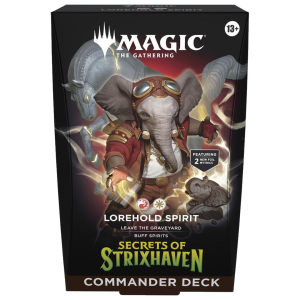
Ikoria companions appeared in regular, showcase and Godzilla-series variants, which makes them fun to collect. Some later printings in Secret Lair drops and supplemental products added more art options. If you build a companion deck, upgrading to a premium version of your companion is a satisfying finishing touch. Browse MTG singles for companions and supporting staples, and check graded cards for high-end collectibles.
If you want to try building a deck from a wide pool, collections can provide cheap, varied cards to experiment with. For a gamble, mystery boxes might surprise you with something useful.
Protecting your companion
A companion is revealed at the start of every game and handled often, so sleeve it. Our accessories include sleeves, deck boxes and binders. If you have spare Ikoria cards you no longer need, consider our sell and trade page.
Sample MTG companion deck ideas
If you want to try an MTG companion without overthinking it, start with one of these concepts. They are casual-friendly and easy to adapt.
Kaheera tribal beasts
Build a Green-White creature deck using only Cats, Beasts, Dinosaurs, Elementals and Nightmares. Kaheera rewards you for sticking to those types, and the restriction naturally gives your deck a strong identity. This MTG companion is a great teaching tool for tribal deckbuilding.
Yorion value pile
Play 80 cards packed with enter-the-battlefield effects, such as creatures that draw cards or remove threats. Yorion resets them all for extra value. The larger deck size slightly lowers consistency, so include plenty of card selection.
Lurrus aggro or midrange
Fill your deck with cheap permanents, then use Lurrus to recast them from the graveyard. In casual formats this is a satisfying grind engine. Check format legality first, since this MTG companion has faced bans.
Obosh or Gyruda numbers games
Choose only odd or even mana values. Obosh pushes an aggressive Black-Red damage plan, while Gyruda supports a Blue-Black graveyard and steal theme. Either MTG companion turns a simple restriction into a puzzle that many players love solving.
Jegantha in five-color decks
Jegantha’s condition is easy to meet if your spells mostly have single colored pips. When it enters, it can produce one mana of each color, which fuels a big turn. Many players found this MTG companion surprisingly flexible for multicolor midrange.
How to evaluate an MTG companion for your deck
A simple test: list every card in your current deck that breaks the condition. If you need to cut fewer than five cards and the replacements are close in power, the MTG companion is probably worth it. If you need to rebuild half the deck, consider whether a different deck would enjoy that companion more.
Common MTG companion mistakes
New players sometimes forget that the condition applies to the starting deck, including cards you might board in after game one. If you sideboard in a card that breaks the condition, you cannot use your companion in that game. Another mistake is forgetting the three-mana special action, trying to cast the companion directly from the sideboard like the original rule allowed.
Players also overvalue companions. A strong MTG companion can be worse than simply running the best cards available without a restriction. Test both versions before committing. Play five games with the companion and five without, and compare how often the extra card actually mattered.
The legacy of the MTG companion design
Few mechanics changed Magic as quickly as the MTG companion did. Within weeks of Ikoria’s release, companions appeared in a large share of competitive decks across formats, which led directly to the 2020 rule change and several bans. Designers have since discussed companions as a lesson about how a free extra card can warp formats.
Yet the mechanic also left a positive mark. Many players love the deckbuilding puzzles it creates, and casual tables still embrace companions as a creative constraint. If you enjoy building with restrictions, an MTG companion is one of the most rewarding ways to do it.
MTG companion FAQ
How does an MTG companion get into my hand?
Once per game, at sorcery speed, you may pay three generic mana as a special action to put your companion into your hand. Then you cast it normally.
Which set introduced the MTG companion mechanic?
Ikoria: Lair of Behemoths, released in 2020, introduced the ten original companions.
Can I have more than one companion?
No. You may reveal only one companion per game.
Is Lutri legal in Commander?
Lutri, the Spellchaser was unbanned in Commander in February 2026. Always check the official banned list for the latest status.
Does a companion count toward deck size?
No. In Commander it sits outside your 100 cards, and in 60-card formats it takes a sideboard slot.
Buying MTG companion online: a practical checklist
Shopping for MTG companion online is convenient, but a little preparation helps you get exactly what you expect. Use this checklist every time you buy Magic: The Gathering products, whether you are picking up a single card, a sealed box or a premium collection.
Before you order
- Confirm the exact product. Check the set name, card number, language and finish in the listing title and photos.
- Read the condition. Singles are usually listed as Near Mint, Lightly Played or similar. Graded cards show the grading company and grade.
- Check stock status. In-stock items ship sooner than pre-orders, which ship when the product releases.
- Compare value, not just price. A bundle with sleeves, dice or promos may be better value than packs alone.
- Know the policies. Read the shipping, returns and contact information before checkout.
When your order arrives
- Open the parcel carefully and check that everything matches the order.
- Inspect singles and slabs under good light straight away.
- Sleeve and store cards immediately so they keep their condition.
- Contact the store quickly if anything is wrong, with photos of the item and packaging.
How to store and care for MTG companion
Good storage protects both the look and the value of MTG companion. Cards are made of layered paper and ink, so heat, light, moisture and pressure all cause damage over time. A few simple habits make a big difference.
- Sleeve first. A soft penny sleeve stops scratches and fingerprints.
- Add rigid protection. Toploaders or semi-rigid holders stop bends for valuable cards.
- Choose the right binder. Side-loading, acid-free binders keep cards secure and easy to view. Avoid ring binders that press into cards.
- Control the environment. Keep cards in a cool, dry room away from windows, radiators and damp basements.
- Store sealed product flat. Boxes and tins last longer stored flat and out of direct light.
- Handle with clean, dry hands. Oils and moisture can mark card surfaces.
You can find sleeves, toploaders, binders and deck boxes in our TCG accessories range.
Useful terms for MTG companion collectors
- Single: an individual card sold on its own.
- Sealed: unopened product in its original factory wrap.
- Pull rate: how often a type of card appears in packs.
- Chase card: the most wanted card in a set.
- Slab: a card graded and sealed in a hard plastic case.
- NM / LP / MP / HP: condition grades from Near Mint to Heavily Played.
- Reprint: a card printed again in a later product.
- Pre-order: reserving a product before its release date.
Common mistakes to avoid with MTG companion
Even experienced collectors make avoidable mistakes. Keeping these in mind will save you money and protect your cards.
- Chasing one card through endless packs. If you need a specific card, the single is almost always the cheaper route.
- Skipping protection. A card left unsleeved for a day can pick up a scratch that lowers its value.
- Buying on hype alone. Prices can move quickly after a release. Check several recent sales before paying a premium.
- Ignoring condition notes. Two copies of the same card can differ greatly in value because of wear.
- Storing cards in the wrong place. Attics, garages and sunny windowsills are hard on cardboard.
- Forgetting your goal. A clear plan, such as finishing a set or upgrading a deck, keeps spending focused.
A simple plan to get started with MTG companion
- Set a goal. Decide whether you are collecting, playing or both.
- Set a monthly budget. Spending a fixed amount keeps the hobby fun and sustainable.
- Mix sealed and singles. Open packs for enjoyment and buy singles for the cards you really need.
- Protect as you go. Sleeves and toploaders cost little compared with the cards they protect.
- Track your collection. A simple list shows what you own and what you still want.
- Sell or trade duplicates. Turn cards you do not need into new additions through a trusted store.
Why shop for MTG companion at TCG Store USA
TCG Store USA is an online trading card shop for collectors and players. We list Magic: The Gathering products with clear titles and photos, separate in-stock items from pre-orders, and offer a sell and trade service when you want to turn cards into cash or store credit. Browse our singles, booster boxes and graded cards, or contact us with any question about an order or product. For official news, rules and release announcements, visit the official Magic: The Gathering site.
Final thoughts on MTG companion
The MTG companion mechanic rewards creative deckbuilding and a bit of patience. Understand the three-mana rule, pick a companion whose condition fits your plan, and test both with and without it. With ten Ikoria options and newer printings, there is a companion for nearly every style. Find yours and the cards to build around it in our shop.