
Pokémon TCG Rules: The Complete Beginner Guide in 10 Easy Steps
Pokémon TCG rules look intimidating the first time you open a deck, but the game is built on a clear, repeatable turn structure. Once you understand setup, the actions you can take each turn, and how attacks and Prize cards work, you can play a full game in under half an hour. This guide walks through every core rule in the order you will actually use it.
We cover deck construction, setup, the turn sequence, Energy, attacking, Weakness and Resistance, Special Conditions, Prize cards and win conditions. The rules described here follow the current Standard rules at the time of writing (November 2026). For tournament play, always check the official rulebook and rulings on the official Pokémon TCG site.

The goal of the game
Each player is a Pokémon Trainer battling with a 60-card deck. You win by knocking out your opponent’s Pokémon and taking Prize cards, though there are two other ways to win as well. Understanding the three win conditions early makes every other part of the Pokémon TCG rules easier to follow.
Deck building under Pokémon TCG rules
A legal deck has exactly 60 cards. You may include no more than four copies of any card with the same name, except basic Energy cards, which have no limit. Every deck needs at least one Basic Pokémon, because you cannot start the game without one.
The three card types
- Pokémon: Basic Pokémon go straight into play; Stage 1 and Stage 2 Pokémon evolve from them. Special variants such as Pokémon ex and Mega Evolution Pokémon ex are stronger but give up more Prize cards.
- Energy: fuels attacks. Basic Energy comes in types such as Grass, Fire, Water, Lightning, Psychic, Fighting, Darkness and Metal; Special Energy cards add extra effects.
- Trainer cards: Items, Supporters, Stadiums and Pokémon Tools. They draw cards, search your deck, heal, switch Pokémon and much more.
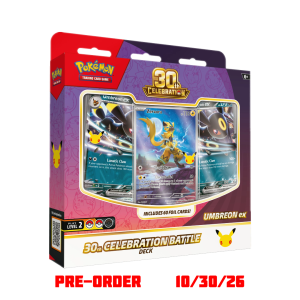
Beginners should start with a preconstructed deck, such as a battle deck or a League Battle Deck, because those are already balanced and legal. You can browse ready-made options and Pokémon singles to upgrade later.
Setting up a game
Setup follows the same steps every time. Practice these until they are automatic, and the rest of the Pokémon TCG rules will feel natural.
- Shake hands and shuffle your deck. Flip a coin; the winner chooses whether to go first or second.
- Each player draws seven cards.
- Choose one Basic Pokémon from your hand and place it face down as your Active Pokémon.
- Place up to five more Basic Pokémon face down on your Bench if you want.
- Set aside the top six cards of your deck face down as your Prize cards.
- Both players flip their Pokémon face up, and the first player begins.
What happens with a mulligan
If you have no Basic Pokémon in your opening hand, reveal your hand, shuffle it back and draw seven new cards. This is a mulligan. For each extra mulligan your opponent takes, you may draw one extra card. Keep repeating until you have a Basic Pokémon to place as your Active Pokémon.
Turn structure in the Pokémon TCG rules
Every turn has three parts: draw, take actions, and attack. Attacking ends your turn, so you always do everything else first.
Step 1: Draw a card
Begin each turn by drawing one card. If you cannot draw because your deck is empty, you lose the game immediately. This is one of the most overlooked Pokémon TCG rules for new players who use too many draw cards.
Step 2: Take actions in any order
- Put Basic Pokémon onto your Bench, up to five Benched Pokémon.
- Evolve Pokémon, but not on the first turn of the game and not a Pokémon that came into play this turn.
- Attach one Energy card from your hand to one of your Pokémon, once per turn.
- Play any number of Item cards.
- Play one Supporter card per turn.
- Play one Stadium card per turn, if a Stadium with a different name is not already in play.
- Attach Pokémon Tools to your Pokémon.
- Retreat your Active Pokémon once per turn by discarding Energy equal to its Retreat Cost.
- Use Abilities, as many as the cards allow.
Step 3: Attack, then end your turn
Choose one attack from your Active Pokémon, check that it has the required Energy attached, and resolve it. After the attack, your turn ends and Pokémon Checkup happens before your opponent’s turn begins.
Special first-turn rules
The player who goes first cannot attack and cannot play a Supporter card on their first turn. They can still bench Pokémon, attach Energy, play Items and use Abilities. Neither player can evolve on their own first turn. These first-turn Pokémon TCG rules balance out the advantage of going first.
How attacks and damage work
Each attack shows its Energy cost on the left and its damage on the right. Colorless Energy symbols can be paid with any type of Energy. When you attack, apply the attack’s effects, then place damage counters on the Defending Pokémon. Each damage counter represents 10 damage.
Weakness and Resistance
Check the Defending Pokémon’s Weakness and Resistance at the bottom of its card. Weakness typically doubles the damage from Pokémon of that type, while Resistance reduces it, usually by 30. Weakness and Resistance apply only to the Defending Pokémon and only to damage from attacks, not to damage placed on the Bench.
Knock Outs
When a Pokémon has damage equal to or greater than its HP, it is Knocked Out. It goes to the discard pile along with all attached cards, and its opponent takes Prize cards. The player whose Pokémon was Knocked Out then promotes a new Active Pokémon from the Bench.
Special Conditions explained
Some attacks leave the Defending Pokémon with a Special Condition. These are among the trickiest Pokémon TCG rules, so it helps to know each one by heart. Only the Active Pokémon can be affected, and moving it to the Bench removes all of them.
- Asleep: turn the card counterclockwise. The Pokémon cannot attack or retreat. Flip a coin during Pokémon Checkup; heads, it wakes up.
- Burned: place a Burn marker. During Pokémon Checkup, put 2 damage counters on it, then flip a coin; heads, it recovers.
- Confused: turn the card upside down. When it attacks, flip a coin; tails, the attack fails and it places 3 damage counters on itself.
- Paralyzed: turn the card clockwise. It cannot attack or retreat, and it recovers after its owner’s next turn.
- Poisoned: place a Poison marker. Put 1 damage counter on it during each Pokémon Checkup.
Which conditions can stack
Asleep, Confused and Paralyzed replace each other, because each one rotates the card differently. Burned and Poisoned use markers, so they can stack with each other and with one of the rotation conditions. A Pokémon can be Burned, Poisoned and Asleep at the same time.
Prize cards and how many you take
Prize cards are the main scoreboard in the Pokémon TCG rules. Knocking out a regular Pokémon gives you one Prize card. Pokémon ex give two, and Mega Evolution Pokémon ex give three. When you take a Prize card, put it into your hand, where it can be played like any other card.
This creates a constant trade-off. Powerful Pokémon ex hit hard but hand your opponent extra Prizes when they fall. Many strong decks mix multi-Prize attackers with single-Prize support Pokémon to make the Prize race harder for the opponent to win.
Three ways to win the game
- Take all six of your Prize cards.
- Knock out your opponent’s last Pokémon in play, leaving them with no Pokémon to promote.
- Your opponent cannot draw a card at the start of their turn because their deck is empty.
If both players meet a win condition at the same time, the game goes to Sudden Death, a new game using only one Prize card each. If one player meets more win conditions than the other, that player wins.
Common Pokémon TCG rules mistakes
- Attaching more than one Energy per turn.
- Playing two Supporters in one turn.
- Evolving a Pokémon the same turn it was played.
- Forgetting to apply Weakness, or applying it to Benched Pokémon.
- Retreating twice in one turn.
- Forgetting Pokémon Checkup damage from Burned or Poisoned.
Rulings and formats
Organized play uses Standard and Expanded formats with rotating legality marks, while casual games can use any cards you agree on. When a card’s text conflicts with the general Pokémon TCG rules, the card text wins. For official tournaments, the Play! Pokémon rules and the current Standard format list are the final authority.
Learning faster with practice
The best way to master the game is to play many short games. Start with two preconstructed decks, read each card aloud as you play it, and walk through each step of the turn together. Pokémon TCG Live is a free way to see rules enforced automatically before you move to paper cards.
When you are ready to grow your collection, booster boxes give you plenty of cards for deck building, while pre-orders let you reserve upcoming products. Collectors can also explore Japanese Pokémon cards and graded cards.
A sample first turn using Pokémon TCG rules
Seeing the Pokémon TCG rules in action makes them stick. Imagine you won the coin flip and chose to go first. You draw your card for the turn, then place a second Basic Pokémon on your Bench. You attach one Energy to your Active Pokémon, play an Item that searches your deck for another Basic, and bench that too. You cannot play a Supporter or attack, so you simply end your turn.
Your opponent draws, benches a Pokémon, attaches Energy, plays a Supporter to draw more cards, and attacks for 30 damage. Pokémon Checkup follows. On your second turn, you can now evolve, play a Supporter and attack. This rhythm, building first and attacking later, is the heart of the Pokémon TCG rules.
Pokémon Checkup in detail
Pokémon Checkup happens between every turn, not just yours. Apply Poisoned first, then Burned, then check Asleep and Paralyzed. Any Knock Outs from Checkup damage are handled right away, and Prize cards are taken before the next turn starts. Forgetting Checkup is one of the most common Pokémon TCG rules errors at kitchen tables.
Retreating and switching
Retreating costs Energy equal to the Retreat Cost printed on the card and can happen only once per turn. Switching cards, by contrast, move your Active Pokémon without paying Energy, and you can use as many as you have. Both remove Special Conditions, which makes switching a strong defensive tool.
Teaching Pokémon TCG rules to kids
Younger players learn Pokémon TCG rules fastest when you skip Special Conditions for the first few games and focus on Energy, attacks and Prize cards. Add one new rule each game. Reading damage numbers aloud and counting Prize cards together turns every match into simple math practice, and the full Pokémon TCG rules will feel natural within a week.
Pokémon TCG rules FAQ
Can the player going first attack?
No. Under current Pokémon TCG rules, the player who goes first cannot attack or play a Supporter on their first turn.
How many Pokémon can I have on my Bench?
Up to five, unless a card such as a Stadium changes that limit.
Can I attach more than one Energy per turn?
Only once from your hand by the normal rule. Some Abilities and Trainer cards let you attach extra Energy.
How many Prize cards does a Mega Evolution Pokémon ex give?
Three. Pokémon ex give two, and most other Pokémon give one.
What happens if my deck runs out?
You lose if you cannot draw a card at the start of your turn.
Buying Pokémon TCG rules online: a practical checklist
Shopping for Pokémon TCG rules online is convenient, but a little preparation helps you get exactly what you expect. Use this checklist every time you buy Pokémon TCG products, whether you are picking up a single card, a sealed box or a premium collection.
Before you order
- Confirm the exact product. Check the set name, card number, language and finish in the listing title and photos.
- Read the condition. Singles are usually listed as Near Mint, Lightly Played or similar. Graded cards show the grading company and grade.
- Check stock status. In-stock items ship sooner than pre-orders, which ship when the product releases.
- Compare value, not just price. A bundle with sleeves, dice or promos may be better value than packs alone.
- Know the policies. Read the shipping, returns and contact information before checkout.
When your order arrives
- Open the parcel carefully and check that everything matches the order.
- Inspect singles and slabs under good light straight away.
- Sleeve and store cards immediately so they keep their condition.
- Contact the store quickly if anything is wrong, with photos of the item and packaging.
How to store and care for Pokémon TCG rules
Good storage protects both the look and the value of Pokémon TCG rules. Cards are made of layered paper and ink, so heat, light, moisture and pressure all cause damage over time. A few simple habits make a big difference.
- Sleeve first. A soft penny sleeve stops scratches and fingerprints.
- Add rigid protection. Toploaders or semi-rigid holders stop bends for valuable cards.
- Choose the right binder. Side-loading, acid-free binders keep cards secure and easy to view. Avoid ring binders that press into cards.
- Control the environment. Keep cards in a cool, dry room away from windows, radiators and damp basements.
- Store sealed product flat. Boxes and tins last longer stored flat and out of direct light.
- Handle with clean, dry hands. Oils and moisture can mark card surfaces.
You can find sleeves, toploaders, binders and deck boxes in our TCG accessories range.
Useful terms for Pokémon TCG rules collectors
- Single: an individual card sold on its own.
- Sealed: unopened product in its original factory wrap.
- Pull rate: how often a type of card appears in packs.
- Chase card: the most wanted card in a set.
- Slab: a card graded and sealed in a hard plastic case.
- NM / LP / MP / HP: condition grades from Near Mint to Heavily Played.
- Reprint: a card printed again in a later product.
- Pre-order: reserving a product before its release date.
Common mistakes to avoid with Pokémon TCG rules
Even experienced collectors make avoidable mistakes. Keeping these in mind will save you money and protect your cards.
- Chasing one card through endless packs. If you need a specific card, the single is almost always the cheaper route.
- Skipping protection. A card left unsleeved for a day can pick up a scratch that lowers its value.
- Buying on hype alone. Prices can move quickly after a release. Check several recent sales before paying a premium.
- Ignoring condition notes. Two copies of the same card can differ greatly in value because of wear.
- Storing cards in the wrong place. Attics, garages and sunny windowsills are hard on cardboard.
- Forgetting your goal. A clear plan, such as finishing a set or upgrading a deck, keeps spending focused.
A simple plan to get started with Pokémon TCG rules
- Set a goal. Decide whether you are collecting, playing or both.
- Set a monthly budget. Spending a fixed amount keeps the hobby fun and sustainable.
- Mix sealed and singles. Open packs for enjoyment and buy singles for the cards you really need.
- Protect as you go. Sleeves and toploaders cost little compared with the cards they protect.
- Track your collection. A simple list shows what you own and what you still want.
- Sell or trade duplicates. Turn cards you do not need into new additions through a trusted store.
Why shop for Pokémon TCG rules at TCG Store USA
TCG Store USA is an online trading card shop for collectors and players. We list Pokémon TCG products with clear titles and photos, separate in-stock items from pre-orders, and offer a sell and trade service when you want to turn cards into cash or store credit. Browse our singles, booster boxes and graded cards, or contact us with any question about an order or product. For official news, rules and release announcements, visit the official Pokémon TCG site.
Final thoughts on Pokémon TCG rules
The Pokémon TCG rules reward patience: learn the turn structure, respect the Prize race, and play plenty of practice games. Once the basics click, you can start building your own decks. Explore Pokémon singles, protect your cards with accessories, or browse the whole shop. Have a rules question about a product? Contact us via the contact page.